GOBBLE / Independent project / Product ownership example
Improve a product through user feedback
The problem
Early users struggled to understand the planning weeks, navigate the tabs, and find guest food considerations.
My contribution
I owned the idea, prioritized usability over a sound enhancement, directed AI-assisted updates, and tested the changes on my phone.
Testing now includes eight participants. An initial three-user usability check demonstrated unassisted dinner setup, guest entry, and identification of the next task.
02 / See the thinking in practice.
Explore an example.
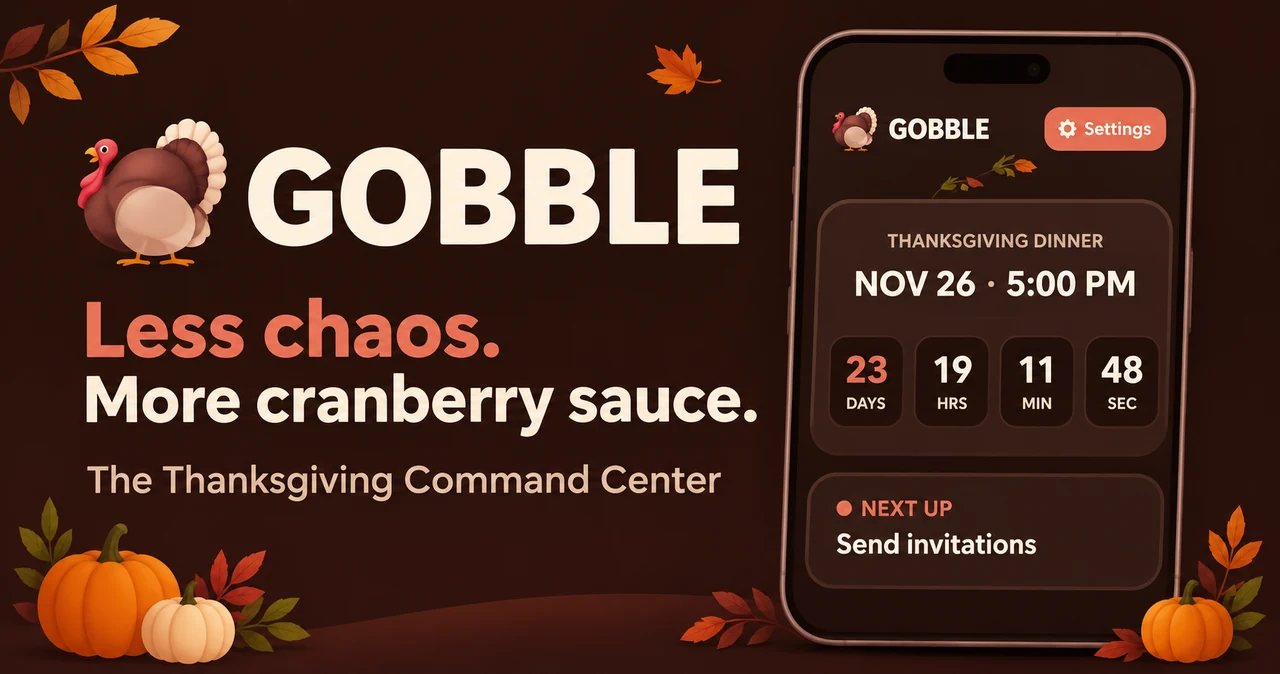
Less chaos.
More cranberry sauce.
See it in practice
Follow the product decisions.
From an original idea to feedback, priorities, and hands-on testing.
A countdown with something useful behind it.
Concept owned by meThe situation
The competition brief was to create a countdown app widget. I wanted to test a more useful and distinctive idea.
My decision or action
I designed a Thanksgiving countdown with a Command Center for the work behind dinner: tasks, guests, food considerations, and preparation.
What supports it
A functional independent product developed with AI assistance, with my ideas and product decisions directing the implementation.
Inspect the supporting detail
This began as a creative hypothesis. I do not describe the original idea as the result of formal market research.
Fix usability before perfecting the turkey sound.
Explicit trade-offThe situation
Feedback asked for simpler navigation, clearer planning weeks, visible food considerations, and a realistic gobble sound.
My decision or action
I prioritized usability for nontechnical users and food considerations because those changes offered more practical value.
What supports it
A clear decision: help people understand the app and see guest needs before adding a more realistic sound.
Inspect the supporting detail
The sound mattered for personality, but it did not resolve the navigation or visibility problems. This is the prioritization decision I described from the project.
Make the next task—and the guest needs—easy to find.
Feedback-informed iterationThe situation
The week field was unlabeled, the terminology felt too project-management-oriented, and guest and turkey information felt disconnected.
My decision or action
I simplified the language, clarified and reorganized the tabs, and added a condensed food-considerations view with appetizer estimates that update with the guest list.
What supports it
Users reported that tasks were easier to add, the current week was clearer, and the tabs were easier to understand and navigate.
Inspect the supporting detail
The product decisions were mine. AI assisted implementation; I reviewed the result and iterated rather than claiming software-engineering expertise.
Could someone use it without me explaining it?
Small usability checkThe situation
I wanted people to set up dinner, add guests and food considerations, and identify what to do next without guidance.
My decision or action
I tested updates locally on my phone against a Notion checklist, refined the behavior, and learned the Google Play testing and release process.
What supports it
Testing now includes eight participants. An initial three-user usability check demonstrated unassisted dinner setup, guest entry, and identification of the next task.
Inspect the supporting detail
Testing began with informal checks and expanded to additional participants. I completed checks but did not consistently maintain the release evidence notes. The initial task check provides qualitative usability evidence, not a market-wide success measure.
03 / Bring it back to the role.
What this demonstrates.
I connect a product idea to user needs, explicit priorities, hands-on testing, and iteration. I own the product decisions while using AI to assist implementation.
Project scope and example context
Independent AI-assisted product with eight testing participants. The initial three-user task check provides qualitative usability evidence, not broad adoption evidence. I used a Notion checklist and phone testing; release evidence notes were not consistently maintained.